
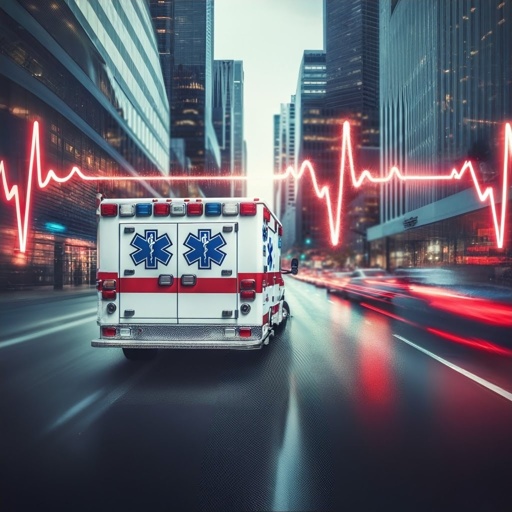
What Are Your Lawsuit Rights When Hit by an Ambulance Running a Red Light in California?
Seeing an ambulance in your rearview mirror usually means someone is in desperate need of help. We are taught from a young age to yield, pull over, and make way for emergency responders. However, when an ambulance is speeding through an intersection against a red light, the situation can turn dangerous in a split second.
If you are T-boned or struck by an ambulance that ran a red light, you are likely facing serious injuries, confusion, and a mountain of questions. Can you sue an emergency vehicle? Does their siren give them immunity? Who pays for your medical bills?
These accidents are legally complex because emergency responders have special privileges on California roads. However, those privileges are not absolute. At Walch Law, we help victims navigate the complicated intersection of traffic law and government immunity to ensure that negligent driving—even by first responders—doesn’t go unpunished.
The “Code 3” Response: Understanding California Law
When an ambulance responds to an emergency call with its lights and sirens activated, it is operating under what is known as a “Code 3” response. Under California Vehicle Code Section 21055, drivers of authorized emergency vehicles are exempt from certain traffic laws during these responses.
This exemption allows ambulance drivers to:
- Exceed the posted speed limit.
- Drive on the wrong side of the road when necessary.
- Proceed past a red traffic signal or stop sign.
However, this is not a “get out of jail free” card. The law includes a critical caveat found in Vehicle Code Section 21056. It states that these exemptions do not relieve the driver from the duty to drive with due regard for the safety of all persons using the highway.
In simple terms: An ambulance can run a red light, but it cannot do so recklessly. They must slow down, check for cross traffic, and ensure it is reasonably safe to enter the intersection before blowing through the signal. If they fail to do this, they can be held liable for the resulting crash.
Determining Liability: Negligence vs. Immunity
Proving liability in an ambulance accident is significantly harder than in a standard car crash. You aren’t just suing a bad driver; you are often suing a government entity (like a city fire department) or a powerful private contractor.
To win a lawsuit after being hit by an ambulance running a red light, we must prove that the driver acted without “due regard” for safety. We look for evidence of specific failures:
Failure to use Sirens Properly
The exemption from traffic laws only applies if the ambulance is sounding a siren as reasonably necessary and displaying a lighted red lamp.
- The “Silent Run” Scenario: If the ambulance driver ran the red light with their lights on but without their siren, they generally lose their legal protection. If you couldn’t hear them coming, they didn’t give you adequate warning to yield.
Blind Intersection Entries
Even with sirens blaring, an ambulance cannot blindly speed through a blind intersection. If a large truck or building obscures the view of cross traffic, the ambulance driver has a duty to slow down almost to a stop to “clear” the intersection lane by lane. Barreling through at 50 mph without visibility is a classic example of failing to exercise due regard.
confusing the Public
Sometimes, ambulance drivers create confusion. For example, if an ambulance slows down as if to stop, prompting you to proceed through your green light, and then suddenly accelerates into your path, their erratic behavior could be deemed negligent.
Who Is Responsible for Your Damages?
Identifying the defendant is a crucial step in these lawsuits. In California, ambulance services are a mix of public and private entities.
- Government Entities: If the ambulance was operated by the Los Angeles Fire Department (LAFD) or another municipal agency, you are suing the government. This triggers the California Tort Claims Act. You must file a specific administrative claim within six months of the accident—a much shorter deadline than the usual two-year statute of limitations for personal injury.
- Private Companies: Many ambulances are operated by private companies like AMR. While they don’t have the same strict six-month deadline, they are often aggressively defended by large corporate insurance policies.
What to Do If You Are Hit by an Ambulance
The moments after a collision with an emergency vehicle are chaotic. Police and other first responders will arrive quickly—often colleagues of the person who hit you. It is vital to protect your own interests immediately.
- Seek Medical Attention: Your health is the priority. Even if you feel “fine” due to adrenaline, see a doctor immediately to document injuries.
- Do Not Admit Fault: You might feel guilty for hitting an ambulance, or an officer might suggest you failed to yield. Do not apologize or admit fault. The question of whether the siren was audible or the intersection was cleared is a matter for investigation, not a roadside confession.
- Gather Independent Witnesses: The police report might favor the ambulance driver. Independent witnesses who can say, “The ambulance didn’t slow down at all” or “I didn’t hear a siren until the impact” are gold dust for your case.
- Check for Cameras: Many intersections have red-light cameras, and nearby businesses have security feeds. Walch Law can move quickly to secure this footage before it is erased.
- Call a Lawyer Before Talking to Insurance: Insurance adjusters know the “emergency vehicle exemption” laws inside and out. They will try to trick you into admitting you heard the siren but didn’t stop.
How Walch Law Can Help You Win
These cases are uphill battles, but they are winnable with the right strategy. At Walch Law, we know how to strip away the protections ambulance drivers hide behind when they endanger the public.
We conduct deep investigations to answer critical questions:
- Was the “emergency” legitimate? (Sometimes drivers use lights/sirens just to bypass traffic).
- Does the “Black Box” data show they braked before the intersection?
- Was the driver properly trained on intersection protocols?
We understand that emergency responders have a tough job, but public safety is a two-way street. If an ambulance driver’s recklessness turned your life upside down, you deserve compensation for your medical bills, lost wages, and pain and suffering.
Contact Walch Law today for a free consultation. We will review the details of your accident, determine if the red-light run was unjustified, and explain your legal options. We handle these complex cases on a contingency fee basis, meaning you pay nothing unless we win. Don’t let the government or an insurance company bully you—call us today.


Comments
There are no comments for this post. Be the first and Add your Comment below.