
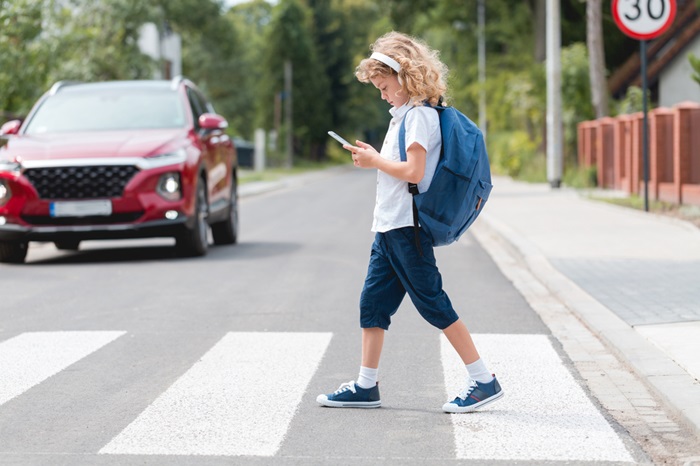
School Zone Pedestrian Accidents in Santa Clarita: Who’s Liable?
The morning walk to school should be the safest part of your child’s day. In Santa Clarita, families cross busy streets near campuses like Saugus High, Valencia High, and dozens of elementary schools every single day. So when a car strikes a child or a parent in a school zone, the shock is overwhelming — and the question that follows is simple but urgent: who is responsible?
The answer is rarely just one person. Depending on how the crash happened, liability may rest with a driver, a school district, the city or county, a crossing guard agency, or a combination of them. This post walks you through how these accidents happen, who may be held accountable, the heightened duty of care that applies near schools, the deadlines that control your case, and the compensation your family may be able to recover.
Key takeaways:
- Liability may fall on a driver, a school district, the city or county, a crossing guard agency, or several parties at once.
- California imposes a heightened duty of care on drivers near schools, including lower speed limits.
- If a public entity may share fault, a strict six-month government claims deadline can apply.
- California generally gives you two years to file a personal injury claim, though the discovery rule can affect that window.
How School Zone Pedestrian Accidents Happen
School zones concentrate the exact conditions that lead to pedestrian crashes: heavy foot traffic, distracted drivers, congestion, and tight timing. Understanding the common causes helps you see where fault may lie.
Distracted Driving
A driver glancing at a phone, a GPS, or a coffee for even a second can miss a child stepping into a crosswalk. In a school zone packed with kids, that split-second lapse can be catastrophic. Distraction is one of the leading causes of pedestrian injuries near schools.
Failure to Yield
California law requires drivers to yield to pedestrians in marked and unmarked crosswalks. Yet many drivers roll through crossings, turn without looking, or fail to stop for a child already in the roadway. A failure to yield in a school zone points squarely to negligence.
Speeding
School zones carry reduced speed limits — often 25 mph or lower when children are present. Drivers who ignore those limits give themselves far less time to stop, and any impact at higher speed is more likely to cause serious harm.
Ignoring Crossing Guard Signals
Crossing guards exist to safely move children across the street. When a driver ignores a guard’s stop signal or paddle, or tries to beat the crossing, the results can be devastating. Disregarding a crossing guard is a clear breach of a driver’s duty. Most school zone crashes trace back to preventable driver conduct — distraction, failing to yield, speeding, or ignoring a crossing guard — and each points toward liability.
California’s Heightened Duty of Care Near Schools
Here’s something many families don’t realize: the law expects more from drivers in a school zone than almost anywhere else.
Every driver in California has a general duty to operate a vehicle with reasonable care. But near schools, that duty is heightened. The law recognizes that children are present, that they’re small and less visible, and that they don’t always behave predictably. Because of that, drivers are expected to slow down, stay alert, and anticipate that a child may dart into the street.
This heightened standard shows up in concrete rules — reduced speed limits, crosswalk protections, and requirements to obey crossing guards. When a driver violates one of these safety rules and injures a pedestrian, that violation can be strong evidence of negligence. Drivers owe an elevated duty of care in school zones, so a safety violation that hurts a child or parent often supports a clear negligence claim.
Who Can Be Held Liable?
School zone cases frequently involve more than one responsible party. Identifying each one directly affects the compensation available to your family, so it’s worth examining every angle.
The Driver
The most direct source of liability is usually the driver. A motorist who was speeding, distracted, failed to yield, or ignored a crossing guard can be held responsible for the injuries they caused. The driver and their auto insurance are often the first place to look.
The School District
A school district may share responsibility depending on the circumstances. Districts have obligations to help keep students safe around campus, and questions worth asking include:
- Were there adequate crossing guards posted where they were needed?
- Was drop-off and pickup traffic managed safely?
- Were known hazards near the campus reported and addressed?
- Did the district follow its own safety protocols for student pedestrians?
Because a school district is a public entity, a much shorter deadline applies — more on that below.
The City or County
Public roads are built and maintained by government agencies, and those agencies have a duty to keep them reasonably safe. When an unsafe road condition contributes to a crash, an injured person may have a claim against the responsible entity for a dangerous condition of public property. Depending on the investigation, questions may include:
- Were crosswalks, signage, or school zone markings missing, faded, or poorly placed?
- Were flashing beacons or signals malfunctioning or absent?
- Was visibility blocked by overgrowth, parking, or poor design?
- Had the agency received prior complaints or seen repeated crashes at the same spot without fixing the hazard?
The Crossing Guard Agency
Crossing guards are sometimes employed or contracted through a city, a district, or a private agency. If a guard was negligent — absent when scheduled, poorly trained, or careless in directing traffic — the responsible agency may share liability. Sorting out who employed the guard is a key early step, because it affects which deadline applies. Liability may rest with a driver, a school district, the city or county, a crossing guard agency, or a combination — and identifying every responsible party early protects your family’s recovery.
The Deadlines That Control Your Case
Time is one of the biggest threats to a claim, so read this section carefully.
The Six-Month Government Claims Deadline
Here’s the deadline that catches families off guard, and it matters enormously in school zone cases. When a public entity — such as a school district, the City of Santa Clarita, Los Angeles County, or a public crossing guard agency — may share responsibility, a much shorter clock applies than the standard two years.
Under the California Government Claims Act, you generally must file a formal written claim with that entity within six months of the date your claim arises. That’s far shorter than two years, and these claims carry strict rules about what they must contain and how they must be filed. A single misstep — a missed deadline, a missing detail, the wrong recipient — can permanently bar an otherwise strong case.
Because so many school zone crashes involve a public agency in some way, acting quickly is essential.
The Two-Year Statute of Limitations
For claims against a private party, such as an at-fault driver, California’s statute of limitations generally gives you two years from the date of the crash to file a personal injury lawsuit. Miss that window, and you can lose your right to compensation entirely.
The Discovery Rule
Not every injury is obvious right away. Some harm — a concussion, an internal injury, or nerve damage — may not surface until later. California’s discovery rule may delay the start of your two-year window until you knew, or reasonably should have known, that you were injured and that the crash was the cause. Because how this rule applies is highly fact-specific, the safest move is to have your situation reviewed promptly. Don’t assume you have plenty of time. If a public entity may be involved, the real deadline could be just six months — so act quickly.
What Damages May Be Recovered
When negligence or an unsafe road causes serious harm, California law lets injured people and grieving families seek compensation for the full scope of their losses — not just the first medical bill. Depending on your situation, recoverable damages may include:
- Medical expenses, past and future — emergency care, surgery, hospitalization, and rehabilitation
- Future care costs, which can be substantial with a child’s long-term injuries
- Lost wages for a parent who missed work during a child’s recovery, or for an injured adult
- Lost earning capacity if injuries limit the ability to work going forward
- Pain and suffering for the physical and emotional toll of the injury
- Emotional distress, including the trauma, anxiety, and fear that often follow a serious crash
- Loss of enjoyment of life when injuries take away activities and independence
- Wrongful death damages for surviving family members — including funeral costs and the loss of love, support, and companionship — in the most tragic cases
In cases involving especially reckless conduct, additional damages meant to punish that behavior may occasionally apply, though those are never guaranteed. The severity of the injury and its long-term impact generally shape what a claim is worth. A strong claim accounts for everything — today’s bills, tomorrow’s care, lost income, and the human toll on your family.
What to Do After a School Zone Accident
A few early steps can protect both your child’s health and any future claim:
- Get medical care right away, even if injuries seem minor — some harm surfaces later.
- Call the police and request a copy of the traffic collision report once available.
- Document the scene if you safely can — photos of the crosswalk, signage, school zone markings, and vehicle position.
- Note the conditions — a missing sign, a faded crosswalk, an absent crossing guard, or blocked visibility can be central to your case.
- Gather witness names and contact information while they’re reachable.
- Avoid recorded statements to any insurer before speaking with a lawyer.
- Talk to the best Santa Clarita pedestrian accident early, so evidence is preserved and the tight government deadline isn’t missed.
The biggest mistake families make is assuming nothing can be done, or that an insurer or public agency will treat them fairly. Neither is a safe assumption.
Key Takeaways
- Santa Clarita school zone crashes often stem from distraction, failure to yield, speeding, or ignoring crossing guards.
- Drivers owe a heightened duty of care near schools.
- Liability may fall on a driver, school district, city or county, crossing guard agency, or a combination.
- A six-month government claims deadline can apply when a public entity is involved, alongside the standard two-year statute of limitations.
- Recoverable damages range from medical costs and future care to wrongful death in the most devastating cases.
Talk to Walch Law Today — Free Consultation
Watching your child get hurt — or losing a loved one — in a place that should have been safe is devastating and deeply unfair. You shouldn’t have to face insurance companies, school districts, and government agencies alone while your family is trying to heal. You deserve answers, and you deserve someone in your corner.
At Walch Law, we help injured people and grieving families investigate school zone pedestrian accidents across Santa Clarita, determine exactly what went wrong, identify every liable party — from an at-fault driver to the agency responsible for a dangerous road condition — preserve the evidence a strong claim requires, protect every critical filing deadline including the tight six-month government window, and pursue the full compensation the law allows. We handle the legal fight so you can focus on your family.
We work on a contingency fee basis. You pay nothing out of pocket, and we only collect a fee if we recover compensation for you. There’s no financial risk in simply finding out where you stand.
Contact Walch Law today for a completely free, confidential consultation. Tell us what happened, and we’ll give you an honest assessment of your case and the next steps that make sense for your family. Don’t wait until a deadline passes or evidence disappears — reach out now 1-844-999-5342


Comments
There are no comments for this post. Be the first and Add your Comment below.